I just completed a MOOC through Coursera called Coaching Teachers: Promoting Changes that Stick. It was offered by Match Education based in Boston. As it stands now in the field there is no particular career path or training leading to positions as instructional coaches and coaches are only beginning to be used in schools for the professional development of teachers.
Instructional coaching itself is a rather new paradigm. A simple explanation is that feedback aimed at improving teacher skills is divorced from the evaluation process. The work that instructional coaches do with teachers does not directly affect the administrative evaluation process. Taking this element out of the picture reduces anxiety and more productively focuses on the intended outcome: improved student learning and performance.
Match's approach has coaches explicitly address teacher mindset. They parry the understandable tendency for teachers to take feedback personally. Instructional practice is evaluated NOT the teacher. I am reminded of the Japanese Lesson Study model I learned of in graduate school (Trinity University in San Antonio).
The Japanese Lesson Study model asks that all teachers consider themselves instructional coaches who work collaboratively with their peer colleagues. The teachers select one lesson, watch one of their group teach it, discuss to create improvements and have another teacher implement them as they watch again. Apparently there can be as many iterations as necessary. Other professional development activities such as Critical Friends and Learning Communities support this empowering and collaborative paradigm.
What would it be like if every teacher were an instructional coach? I found that taking this MOOC increased reflection and self-assessment of my work as a teacher, not just as a coach. Surveying the course as a lone teacher will prove productive. But, what if those who teach the same course or a whole department or a school all take the course?
Friday, December 5, 2014

New Science Technology/Engineering Standards in Massachusetts
The public school teachers of Massachusetts are to implement new Science Technology/Engineering Standards come fall 2015. These new standards grow out of the United States national Next Generation Science Standards. These standards in turn complement the United States national Common Core Standards for math and English language arts.
How is a teacher to transition to these new standards? In order to begin to understand the standards two methods come to mind: focus on the novel emphases and compare the old and new standards. The new standards press us to help students come to understand and practice the methods of science such as modeling, argumentation and planning and caring out investigations. The content or disciplinary core ideas remain essentially the same but are reorganized into large overarching themes. The standards themselves are stated in goal oriented language such that they describe what a student is to do in order to learn and exhibit understanding. Here is an example of this approach applied specifically to the high school level biology standards. The theme of interest is modeling. Resources to support development of compliant lessons are included.
How is a teacher to transition to these new standards? In order to begin to understand the standards two methods come to mind: focus on the novel emphases and compare the old and new standards. The new standards press us to help students come to understand and practice the methods of science such as modeling, argumentation and planning and caring out investigations. The content or disciplinary core ideas remain essentially the same but are reorganized into large overarching themes. The standards themselves are stated in goal oriented language such that they describe what a student is to do in order to learn and exhibit understanding. Here is an example of this approach applied specifically to the high school level biology standards. The theme of interest is modeling. Resources to support development of compliant lessons are included.
Thursday, September 11, 2014
Philosophical Integrity
I'm a big fan of MOOC's (Massive Open Online Courses). One of the latest I surveyed was Leaders of Learning by Dr. Richard Elmore of Harvard. I found it to be a necessary update of my Educational Leadership course of more than a decade ago from the late beloved Dr. Sergiovanni at Trinity University. One thing Dr. Elmore advised was to find out what one's educational philosophy is (he provides a survey and four domains) and then find an educational environment that closely matches it. He rather emphatically emphasizes that such a tack is necessary for health and happiness. A decade ago following such advice was limited. Today, although still not easy, it is within the realm of possibility to do so. The education sector is expanding to accommodate what were once considered revolutionary perspectives on learning.
I expect to be healthier and happier as I participate in the education sector in a way consistent with my personal paradigm. I'll keep you updated.
I expect to be healthier and happier as I participate in the education sector in a way consistent with my personal paradigm. I'll keep you updated.
Thursday, November 29, 2012
Doing the Candium Lab Differently
When I began teaching high school chemistry I inherited many wonderful resources. One notable one was the popular Candium Lab. A search of the Internet will produce a multitude of versions of this activity which addresses average atomic mass. Virtually all of them, like the one I discovered, are cookbook labs. The average atomic mass is described, an algorithm is provided for determining the average mass of a sample of a mixture of three candies. Most also provide the data tables and additional practice problems.
When I first used the lab my students found it very confusing. I was answering questions for each lab group all through it. I first wrote it off as my fault. I hadn't done it before and so I hadn't properly prepared them to do the lab. Then I thought about the type of questions they were asking. They didn't seem to know why they were being directed to do what the lab handout said to do. They were just going through the motions. The intent of this lab is to model the process by which we determine the average atomic mass of each element based upon the relative mass and abundance of each its isotopes. I didn't think that the students were seeing it as a model. They thought of the lab activity as just one more set of instructions to follow which happened to end with eating candy.
I wanted them to be conscious of the analogy and to think through the process required for themselves. Since one of my goals is to get my students to practice the skills of scientists I begin the course by teaching them to not only make their own data tables during experimentation but to design procedures. I decided to makeover the Candium Lab as a challenge. After direct instruction and guided practice in determining average atomic mass I presented the lab activity as independent practice. I did not print out a lab guide or fill-in sheet. I merely dumped the three types of candy into a large clear bowl and mixed it up. I told the students that I wanted them to determine the average [atomic] mass of a fictitious element "candium." The bowl represented the candium found in all of nature, their dixie cup portion a sampling of it. I asked that each lab group come up with a procedure for doings so and then to call me over to hear, refine with them if necessary, and approve their procedure.
The fallout was clear. The students were aware of the model. They applied the procedural knowledge from the lecture and practice to a new novel situation. Additional positive results included a sense of satisfaction in rising to a challenge and confidence building in using basic mathematical skills to solve a science problem. A lesson learned was that students do not need to have everything completely scaffolded for them and indeed should not if we want them to joyfully truly learn.
Another alternative modification would be to place the candium activity at the beginning of Bruner's Discovery-Introduction-Application Model. Here one would treat the candy merely as candy and ask for the average mass of a piece of candy given that there are three types of candy present in a variety of abundances. Then one would reveal the analogy and give practice with another application of the procedural skill set involved.
When I first used the lab my students found it very confusing. I was answering questions for each lab group all through it. I first wrote it off as my fault. I hadn't done it before and so I hadn't properly prepared them to do the lab. Then I thought about the type of questions they were asking. They didn't seem to know why they were being directed to do what the lab handout said to do. They were just going through the motions. The intent of this lab is to model the process by which we determine the average atomic mass of each element based upon the relative mass and abundance of each its isotopes. I didn't think that the students were seeing it as a model. They thought of the lab activity as just one more set of instructions to follow which happened to end with eating candy.
I wanted them to be conscious of the analogy and to think through the process required for themselves. Since one of my goals is to get my students to practice the skills of scientists I begin the course by teaching them to not only make their own data tables during experimentation but to design procedures. I decided to makeover the Candium Lab as a challenge. After direct instruction and guided practice in determining average atomic mass I presented the lab activity as independent practice. I did not print out a lab guide or fill-in sheet. I merely dumped the three types of candy into a large clear bowl and mixed it up. I told the students that I wanted them to determine the average [atomic] mass of a fictitious element "candium." The bowl represented the candium found in all of nature, their dixie cup portion a sampling of it. I asked that each lab group come up with a procedure for doings so and then to call me over to hear, refine with them if necessary, and approve their procedure.
The fallout was clear. The students were aware of the model. They applied the procedural knowledge from the lecture and practice to a new novel situation. Additional positive results included a sense of satisfaction in rising to a challenge and confidence building in using basic mathematical skills to solve a science problem. A lesson learned was that students do not need to have everything completely scaffolded for them and indeed should not if we want them to joyfully truly learn.
Another alternative modification would be to place the candium activity at the beginning of Bruner's Discovery-Introduction-Application Model. Here one would treat the candy merely as candy and ask for the average mass of a piece of candy given that there are three types of candy present in a variety of abundances. Then one would reveal the analogy and give practice with another application of the procedural skill set involved.
Wednesday, November 14, 2012
Some Why's and How's of Interdisciplinary Studies
WHAT ARE THE BENEFITS OF DOING
INTERDISCIPLINARY WORK?
The
benefits of a wider application of interdisciplinary studies are numerous.
Time Savings - For example: as a science teacher, I don’t
have to go into the details of a historic period to give context when I
describe a technological advance.
Support
System for Teachers – Doing it alone in the classroom is challenging. I am not a historian or musician. If I work with a heterogeneous team of
teachers I can access their expertise and feel confident about the
interdisciplinary aspects of the work.
Authentic
– It’s Real. Disciplines are
arbitrary and artificial.
Engaging
– Given that a compelling theme is chosen student and teachers experience joy
in learning. Students understand in the
moment ‘why they need’ to learn something.
All are challenged.
Differentiated
– Each student’s resources vary with their course schedule. If culminating work is done in the advisory
or other mixed groupings then each contributes unique perspectives. If cooperative project based summative
assessment is incorporated, students have a chance to use talents not always
used in traditional testing situations.
School
Spirit and Camaraderie – The whole school community has a common thought on
their minds.
HOW MIGHT INTERDISCIPLINARY
STUDIES BE STRUCTURED WITHIN A SCHOOL?
A. As A Whole School
i. Year
Long
Examples: Topical: Can Solar Energy Save Us?
Big
Idea/Value: Courage
Historical: They Made a Difference, I (We)Can Make a
Difference
The school, grade levels, departments or
courses could develop their own themes/essential questions based upon the
topic. Courses run as usual. Answering the essential question or
responding to the theme plays as big a role as teachers or departments choose.
ii. Stop
Everything Discrete Events
Example: “What’s So Super About
the Superbowl?”
Each discipline/department presents
instruction (drawn from existing objectives) that supports the theme. This might engage the whole school for one
week. All instruction is within the
context of the theme. At the end of the week
advisory groups might make presentations. (This example comes from North
Central Charter Essential School in Fitchburg, Massachusetts)
B. By Grade Level
i. Year Long – The teachers (and perhaps students) of each grade level brainstorm a theme. Or the administration assigns a general topic and the teacher and students brainstorm a theme. Work in courses continues pretty much as usual but reference is made to the theme whenever a teacher or student detects a connection. A final semester project might become a combined final exam or a component of the disciplines’ final exams.
i. Year Long – The teachers (and perhaps students) of each grade level brainstorm a theme. Or the administration assigns a general topic and the teacher and students brainstorm a theme. Work in courses continues pretty much as usual but reference is made to the theme whenever a teacher or student detects a connection. A final semester project might become a combined final exam or a component of the disciplines’ final exams.
Example:
Big Idea –
Beauty, Brainstormed Theme – “Is Beauty
Really More Than Skin Deep?”
Parallel Studies – This could be
started with just one term. Take the existing curriculum in each
discipline. Brainstorm as a grade level
to find a correlating theme that could run through all disciplines. Each teacher implements their usual objectives
but does so at a time matching the other disciplines that have content that
support the theme. Each discipline might
decrease its own summative assessment level and trade out for one shared
interdisciplinary project which would serve as at least a portion of the
summative evaluation in the discipline based course. These are usually thematic.
Ex. “What Does It Take to Be A Man?”
Biology – Human Genetics/Disorders, Mitosis,
Meiosis
English – Tarzan
Social Studies – almost any war?
PE – Endurance, Limits of Man’s Physical
Abilities
Math – Statistics, Measurement
Art – The Golden Mean
(This example is from North
Central Charter Essential School in Fitchburg, Massachusetts)
Stop Everything Discrete Event – As
with whole school situation but limited to a grade level. It would be least disruptive if each grade
level had one running at the same time. At NCCES the essential question "What's So Super About the Superbowl?" drove a successful week long interdisciplinary mixed grade-level unit.
C. By Linked Courses – A section
of each participating course would be set aside for students committed to
parallel enrollment in two or more classes. Teachers would correlate some points of
instruction.
Examples:
Mad Men and Monsters: Literature – Psychology – Biology
(This example, in part, comes from Quabbin Regional High School in Barre, Massachusetts)
(This example, in part, comes from Quabbin Regional High School in Barre, Massachusetts)
Food: History – Chemistry – English - Sociology
Advisory
Connection
Synthesis of the interdisciplinary
studies can be accomplished in advisory.
Extended advisories at the end of units of study allow for preparation
of final cooperative presentations.
Students in advisories may have very different course profiles. However, if the theme is school-wide or
grade-level wide with grade-level advisories this only enhances the breadth and
depth of the experience for students.
Tuesday, November 13, 2012
THINGS THAT WORK - Printed Sticky Notes
It has seemed magical to my students when I have used custom printed sticky notes. I have made matching games:
terms/definitions
type of nuclear radiation/description/nuclear symbol
They are even more thrilled when I make little reference sheets on the sticky notes for them to keep:
conversion factors
most abundant elements
(1. print, 2. stick notes over the printed area - orienting so that the stick end of the note will enter the printer first, 3. put through the printer again, 4. remove sticky notes, 5. repeat from step 2 until you have enough for your class)


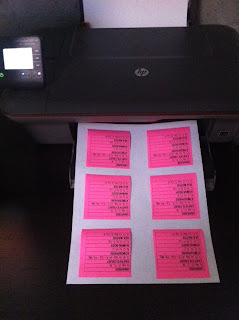
Here is a link to blank templates so you can make your own.
Sticky Note Printing Template
terms/definitions
type of nuclear radiation/description/nuclear symbol
They are even more thrilled when I make little reference sheets on the sticky notes for them to keep:
conversion factors
most abundant elements
(1. print, 2. stick notes over the printed area - orienting so that the stick end of the note will enter the printer first, 3. put through the printer again, 4. remove sticky notes, 5. repeat from step 2 until you have enough for your class)


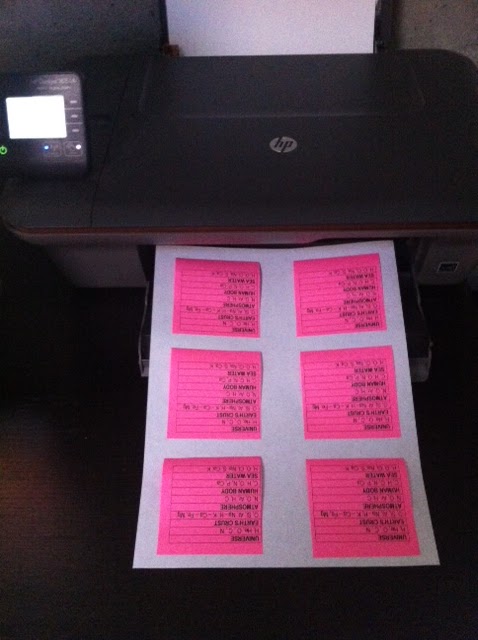
Here is a link to blank templates so you can make your own.
Sticky Note Printing Template
Friday, October 12, 2012
THINGS THAT WORK - Daily Lesson Sheets
Students need to understand what is expected of them, know what will be happening and reflect upon their effort and comprehension. One routine way that I do this is by using Daily Lesson Sheets. I limit these sheets to a half-sheet of paper. This makes them less intimidating to students and distinguishes them from worksheets that we might be using. It also helps me distil the objectives and work of the day down to the most important elements. I find this strategy particularly useful for students who don't seem to know what is going on even though the objectives and agenda are posted on the board or published in the syllabus. This device supports students in beginning steps to taking responsibility for themselves.
FRONT SIDE
Subject - Unit Title - Sub-unit Title
Remind the student of the subject, topic and particular focus of the current work.
Essential Question
Confirm the unit question. Introduce an essential question of the day if appropriate.
Objectives
Here is where the curriculum objectives, in accessible language, are found. They come from the unit plan which in turn is based upon state and national standards.
Agenda
The anticipated schedule for the class period.
I have the students read through this side with me at the top of the class period.
BACK SIDE
Formative Assessment
A relevant question or prompt the response of which guides the teacher in choosing next steps.
Self-Assessment of Understanding and Effort
A request for the student to reflect upon the objectives of the day in order to determine what they know and evaluate what they did. Students share insights and identify questions they have.
Students acknowledge the amount of effort they invested in the learning.
Save at least the last ten minutes for this side of the sheet. I circulate and stamp or sticker off this backside having a quick look and short interchange with students. Whole group sharing before stepping out the door is validating. If I have not been able to capture the formative assessment sufficiently during my circulation I will collect the sheets, review, give feedback and return them the next class period.
Here is a blank template. Copy one-sided to two-sided, half as many copies as students and cut in half.
Here is a model.
What should one do if the class ends before everything is done? Halt and continue at the next class period. Ask the students to hold onto the sheets for the next day or collect them (with their names on them). I have found that one sheet can be stretched over two days but it loses efficacy for any longer durations.
FRONT SIDE
Subject - Unit Title - Sub-unit Title
Remind the student of the subject, topic and particular focus of the current work.
Essential Question
Confirm the unit question. Introduce an essential question of the day if appropriate.
Objectives
Here is where the curriculum objectives, in accessible language, are found. They come from the unit plan which in turn is based upon state and national standards.
Agenda
The anticipated schedule for the class period.
I have the students read through this side with me at the top of the class period.
BACK SIDE
Formative Assessment
A relevant question or prompt the response of which guides the teacher in choosing next steps.
Self-Assessment of Understanding and Effort
A request for the student to reflect upon the objectives of the day in order to determine what they know and evaluate what they did. Students share insights and identify questions they have.
Students acknowledge the amount of effort they invested in the learning.
Save at least the last ten minutes for this side of the sheet. I circulate and stamp or sticker off this backside having a quick look and short interchange with students. Whole group sharing before stepping out the door is validating. If I have not been able to capture the formative assessment sufficiently during my circulation I will collect the sheets, review, give feedback and return them the next class period.
Here is a blank template. Copy one-sided to two-sided, half as many copies as students and cut in half.
Here is a model.
What should one do if the class ends before everything is done? Halt and continue at the next class period. Ask the students to hold onto the sheets for the next day or collect them (with their names on them). I have found that one sheet can be stretched over two days but it loses efficacy for any longer durations.
Subscribe to:
Posts (Atom)